What’s Up in the classroom
CAMPING STORE: Since our families have brought in camping supplies the children designed the camping store layout and organized the shelving. We have made labels for our shelves, barcodes, and price tags for each item. Reasoning and exchanging skills are in full effect! The children have thoughtfully put an amount on each item, for example, a large hammock should cost more than one water bottle. The students created name tags, to express they are workers in the store rather than a customer. Many students were interested in store hours and created a clock to tell when the store is closed or open for business. Some have even began advertising and encouraging other students to come buy supplies. We are continuing to discuss coins and bills. While the children have expressed knowledge about the idea of going to a store, you can further their thinking by having conversations with your child when you’re at the store. Look for store signs to direct you to where you would find an item. Discuss where you found the cost of the item and have them read the numbers. Talk about different jobs throughout the store: stocker, cashier, etc. The children are excited about camping and just waiting for the weather to warm up to take their camping knowledge back outdoors! Until then we have brought the outdoors in, as we are representing night sky motions through dance.
 |
| Counting money in exchange for supplies at the camping store. |
Slats: The thinking that began in the fall continues to thrive. While the children have ironed out concepts about connection and stability, they continue to challenge themselves as new features are added. For instance, they are working to develop “switches” where the marble changes track. A part of this is to have the marble “jump” onto another slat or into something at the end. They are also figuring out how to get sound into the motion by having the marble roll into, onto, and through metal objects. All of these challenges are developing their problem solving skills and giving them opportunities to develop mathematical thinking as they measure distances and plan for sequence. In order to solve social logistics, the children have identified all the roles necessary to accomplish a slat goal. We now have nametags to identify who is doing each job. While everyone wants to be the “launcher”, no one can launch if there is not a “planner”, “builder”, or “fixer”. Another thread of thinking the children continue to follow is regarding turns. Watching a video of a previous kindergarten class inspired the idea to achieve more than 10 turns. The children are determined to get the marble to make “twenty turns” in one launch. They are on their way as they have developed a theory that “the one before has to be one more” in regard to how tall the slat base is built. This thinking is provoking problem solving and many science concepts regarding motion and ricocheting (“bump”).
 |
| Group time to solve the problem of getting the marble to turn. |
Garden: 2-4-6-8! Meet me at the garden gate!! We have been dreaming about the garden by building models and perusing garden books and studying our amaryllis.
 |
| Using the garden map to make a model of our garden. |
Last week in the garden, the children found the thyme poking through the snow. This week we found lots of rabbit dung...stay tuned!
We look forward to sharing all of the details with you at the program exhibit on April 8th.
Thanks, as always, for sharing your child with us!!
We wish you a sunny and splendid spring!
Aubrey Smith and Cyndi McAuliffe
Notes from the interns:
Mr. Brown:
During this semester, the
children have shown a keen interest in exploring roles in various settings. The
interest first stemmed from performing a story we read together called The
Soup Opera. In this story, a problem arises and various characters
come together to resolve the issue. This theme has continued in much of our
exploration throughout the semester.
The children have been
exploring roles in much of their everyday explorations. Roles have popped up in
numerous areas such as dramatic play. With dramatic play, the children have
been exploring roles with planning on what to build, who is the builder, what
costumes to use and what characters they wish to explore in their new setting. Most
recently the children have been writing letters to family members and as well
as each other. The purpose is for children to explore the role of being a
writer, as well as a reader. The children have been writing letters to children
in the classroom and keeping in mind as a writer who will be reading them. The
purpose is to write to a wide variety of audiences.
As this exploration
continues, we will focus on the perspectives of people who will read our
letters and how roles fit into the delivery of letters. We will be writing to
family, previous teachers, and fellow classmates. We have been designing maps
of our classroom and school to aid us in the successful delivery of our
letters. We hope to create mail boxes for the respective classrooms that will
be utilized to each classroom’s needs. The children will have to design and
construct the mail boxes by looking at the physical and logistical perspectives
of the children in each of the classrooms.
With the children writing
letters, this exploration coincides with early childhood standards by
strengthening the children’s writing through drawing, dictation, and teacher support. Roles
play a vital aspect in early childhood standards by working together through
positive support to solve classroom goals.
We encourage
families to extend the children’s exploration in writing letters or postcards
to the classroom. If your child sees you writing or mailing a letter, tell them
why you are sending the letter and how the letter will be mailed. We wish for
the children to see how much is involved in mailing letters locally, even
internationally!
Ms. Smart:
Throughout
the duration of this semester, the children have shown an interest in art and
the process of representation. This interest was first brought to my attention
during a group project that focused on recreating experiences at the beach or
painting what they thought of when they heard the words such as ocean, water,
and shells. The children took to this
project fairly quickly, adding images of sea life, a beach, and water. What was
even more intriguing about their representation was the details they chose to
include. Some animals were painted over to give depth to the painting,
representing the animals being underwater. Along with that, many of the animals
were painted from a front profile view though the beach and water suggested an
aerial view.
To
continue working with the children’s misconceptions about representation and
build on their current interest with recreating, we then moved on to exploring
different perspectives and times of representation in art. Pablo Picasso’s Three Musicians was investigated due to
the way the artist represented people by shapes rather than the typical form of
representation. An aerial view of a city was also analyzed. This brought focal
points to the attention of the children and provoked their imagination into
what else the painting could possibly represent.
Most
recently, the children have begun focusing on Zulie, parrot who is housed at
the Early Childhood Education Center. While exploring the shapes and angles
seen when observing Zulie, the children have begun creating their own representation
through drawing.
From here, we plan to
continue exploring perspectives within drawings and move our explorations to
representing our ideas with various materials in a 3D manner. This will provoke
the children to think about perspective and the process involved in developing
a piece of art moving from a 2D representation, to a 3D representation.
Stacking materials, problem solving how to stick materials together, and
collaboration are some components that will also be included within our
explorations.
We
encourage families to participate in this exploration by extending this
learning within the home! Tours of famous artists work such as Picasso, Van
Gogh, and Seurat are a few examples of artists who create representations of
everyday things but do so in a different and interesting way. These artists
work can be viewed at the Detroit Institute of Arts but also online through
their virtual tours! Along with explorations of 2D representations, working
with clay, play dough, or other materials to create a 3D representation
instills problem solving and spatial skills necessary for development!
As we move along
through this semester, we also encourage you to attend our upcoming Curriculum
Night. This will take place on Wednesday, April 8th. On this night, you will
have the opportunity to explore all the hard work of the children throughout
the semester. We look forward to seeing you!


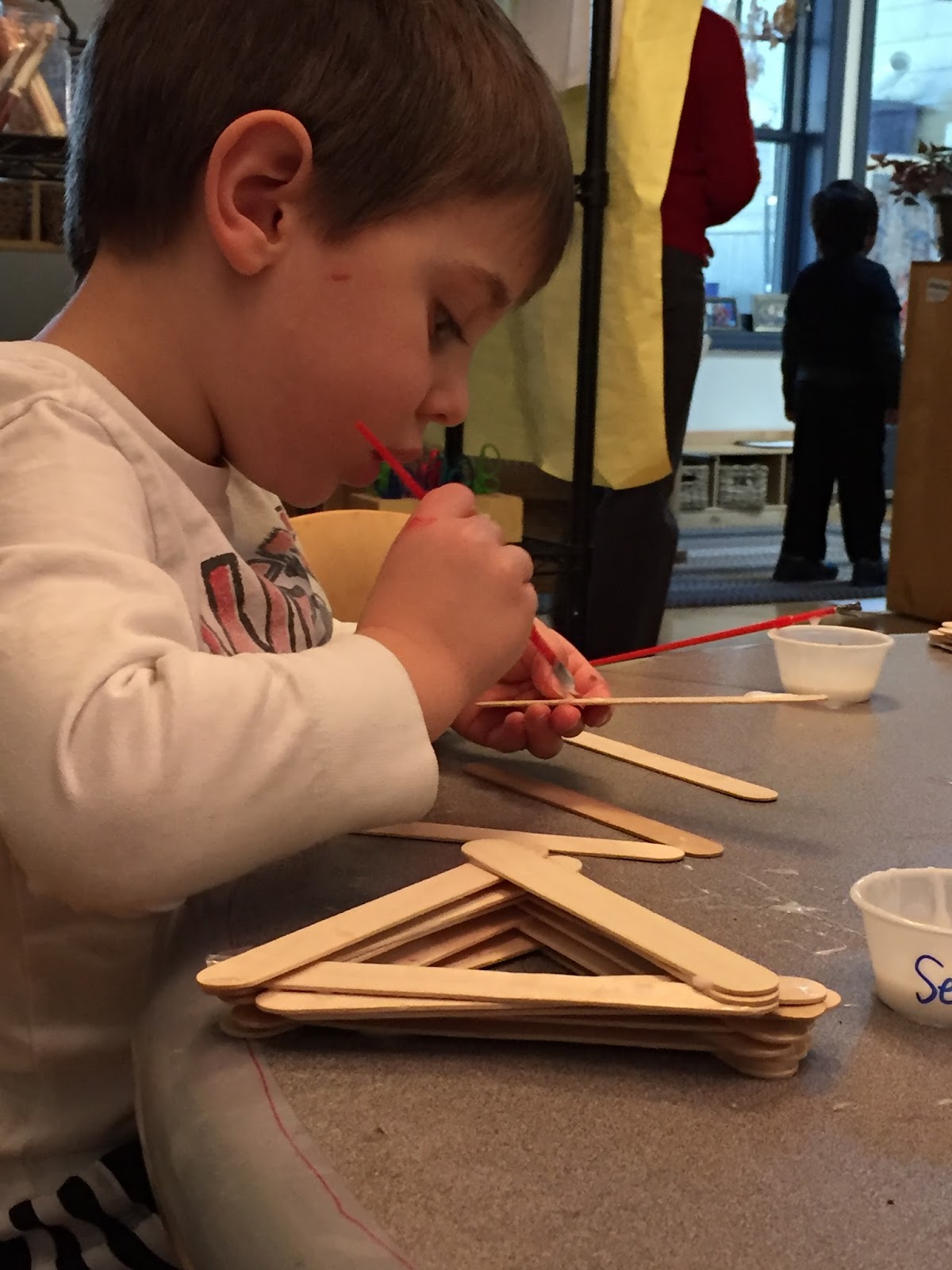
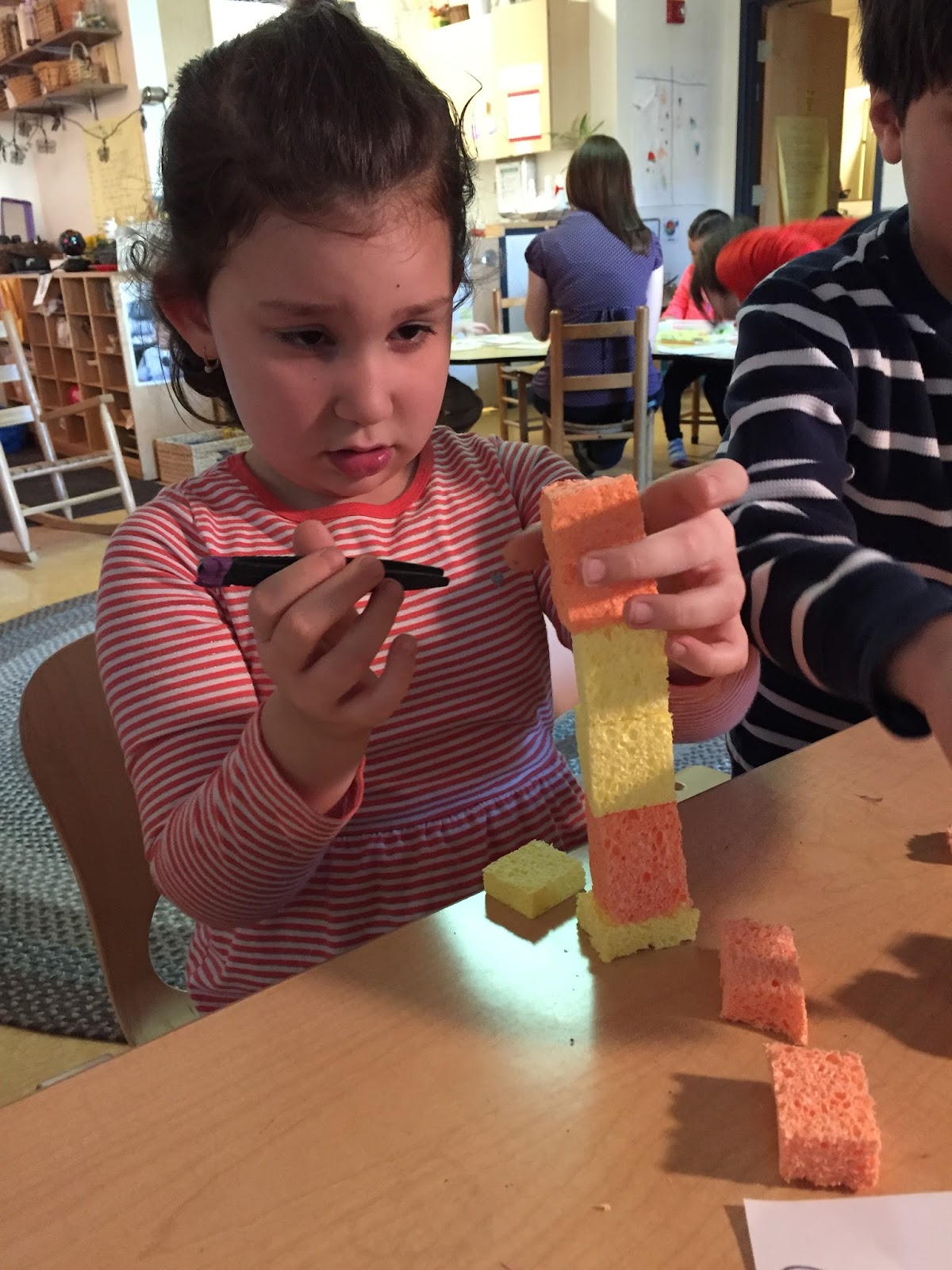 While learning about the children's interests in the classroom I couldn't help but notice an interest in building and movement shown by the class as a whole. The children were actively learning about Adam with Mrs. Roy in the art studio. Who is Adam? A wooden human figurine They were learning about how to change flat objects into 3D shapes. I wanted to expand the children's thinking about 3D shapes. My first implementation was creating those shapes from flat craft sticks. While building, the children were focused on making their shape sturdy in order for it to stand up. From the thought of creating a sturdy structure we began investigating sturdy in multiple functions. We have made sturdy stacks using tweezers and sponges, as well as blocks and cups. We have now expanded the concept of sturdy into developing a sturdy classroom community focusing on our problem solving and team working skills. To continue our investigations we will include the thought of sturdy while moving into exploring: sorting, storytelling, problem solving and balancing.
 K-2-ETS1-2 Develop a simple sketch, drawing, or physical model to illustrate how the shape of an object helps it function as needed to solve a given problem.